Early Rupert Neve Consoles and their stories | PART TEN: 1972-1973 | ‘Free-grouping’ at LWT and Neve Mic Amps change some more.
Researched and written by DAVID TAYLOR
With information and photographs by JOHN TURNER
And further assistance from BLAKE DEVITT
Thanks to John and Blake for providing the important Neve documentation to help provide an accurate history.

This website should ‘scale’ for viewing on a desktop, and smaller laptop and mobile devices. However it is best viewed in ‘landscape’ on your phone.
This section is dedicated to CBS’s Mike Ross-Trevor:
A superb recording engineer and extremely friendly guy whom I met occasionally when working in Whitfield Street, my own favourite recording studio for the TV music that we recorded at London Weekend TV in the ’70s and early 80’s.
Although Mike started with the usual rock band’s in the late 60’s, he was adept at the smaller classical orchestras that CBS recorded in Studio 1 and he moved to recording big film-scoring orchestras later on, as the London CBS studios became Sony Studios and the Hit Factory.

THE ‘TECHNICAL’ CONTENTS
If you’re interested in just the ‘techy bits”, these can be accessed via the ‘jump’ facility using the following numbered section ‘IDs’, and then the browser’s ‘Back’ button’ to come back here again:
80| 1972: CBS Whitfield Street’s 24-channel 16-group consoles – Neve’s ‘A314 and A346’
80a| Neve 1080 mic-amp module
81| 1972-1973: London Weekend TV’s three 30-channel consoles –Neve’s ‘A328 to A330’
plus two 12-channel Submixers – Neve’s ‘A291-A292’.
82| 1972: London Weekend TV’s 8-channel Grams Mixers – Neve’s ‘A293-A296’.
83| 1972: Yorkshire Television’s 20 channel 4 group Film Dubbing console – Neve ‘A392’
84| 1972: Decca Records 2-channel Tape Transfer consoles – Neve’s ‘A340 and A341’
85| 1972: 30-channel 16-group console for ‘Société Francaise du Son’ – Decca Paris – Neve ‘A599’
85a| Neve 1081 mic-amp with 4-band EQ
80| 1972: CBS Whitfield Street’s 24-channel 16-group Neve’s –‘A314’ and ‘A346‘
CBS London Recording Studios, 31-37 Whitfield Street, London W1T 2ST
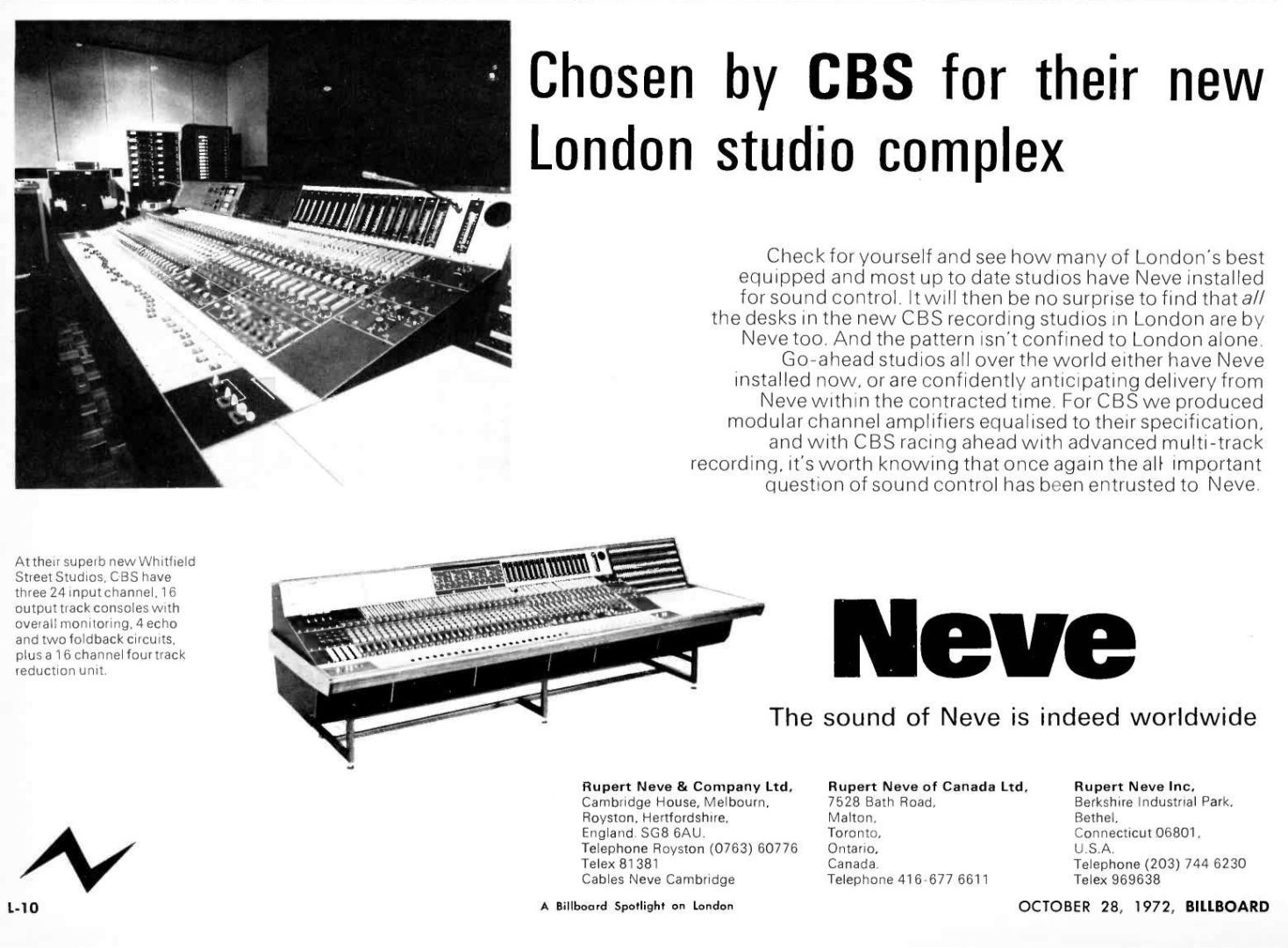
CBS London moved into a band new purpose-built studio complex in 1972 for which Neve provided 2 new 24-channel 16-group consoles based on the CBS Neve ‘A69’ that had gone into the previous studios in New Bond Street. CBS had also been using their Theobald’s Road premises as their re-mix room and from there came the smaller ‘A27’, to be the re-mix desk at Whitfield Street. For more information on the earlier CBS Neve’s see this article here
JOHN TURNER:
The considerable design work for the second console for Theobalds Road, ‘A69’, was done between February and April 1970. This second studio console was pretty certainly the same actual design as consoles 3 & 4 (‘A314’ and ‘A346’) delivered later, as only a couple of additional drawings were required for ‘A314’ and ‘A346’ for the new Whitfield Street Studios. ‘A69’ was probably fitted with the same 1066 Channel Modules. However a special 1080 Channel Module with both high pass and low pass filters, and revised concentric ring controls was designed specifically for the latter two CBS consoles.

The lightbeam meters were specified by the CBS Technical Manager George Balla, and had been fitted to the two previous consoles at New Bond Street and Theobald’s Road. The Altec speakers that CBS brought from their other studios didn’t find favour in the new rooms and were soon replaced with JBL’s.
It was surprising that CBS didn’t choose to go with for 24-track consoles though, as in 1971/2 as the other big London studios had all started to plump for more outputs. This was more noticeable after Whitfield Street did buy 24-track multi-tracks, as you could still only record 16-tracks at once. Tracking most pop bands this wasn’t too much of a restriction, but for Mike Ross’s bigger sessions it was probably why CBS went and bought 24-Track MCI in-line desks in the early 80’s.
JOHN TURNER:
‘A346’, the fourth console to be supplied was fitted with the Neve 2254/A Limiter compressors, when it was photographed at the Neve headquarters in Melbourn below, but the 2254/D version was manufactured specifically to CBS requirements under project ‘A348’. Quite a few modifications to the standard 2254 were required for the /D version, as can be seen from the drawings and general spec sheet.
This 2254/D version changed both the Limiter and Compressor recovery times, so that both had a total of six; 100 mS/200 mS/400 mS/800 mS, 1.5 Sec and Auto. The Compressor also got an additional ratio of 10:1, but also did retain the gentle 1.5:1.”

Here ‘A346’ still has 4 vertically mounted Studer Tape Remotes on the left side and the blanking panels in the upstand, are awaiting the UA 1176 limiters that CBS favoured.

MIKE ROSS-TREVOR, SENIOR RECORDING ENGINEER FOR CBS LONDON:
“New Bond Street was not considered by the American guys to be a serious studio. The fact that we were churning out loads of hits was by the way. It wasn’t considered a great orchestral room. So a lot of the American producers who came over and wanted to do orchestral projects would go to Olympic in Barnes, Abbey Road and CTS. CBS suddenly realized they were spending an awful lot of money in these studios for their visiting artists. People like Tony Bennett and Barbra Streisand would come over and they were recording in all of these other studios. So they decided they needed a decent big orchestral room with all the facilities, so they built this place.
They cleared the site in 1970, and we opened in June 1972. It was designed by a Dutch guy called Van Kleven, who also designed A&M studios in Los Angeles. Back then we had several people from the States come in and say, ‘My God, it’s A&M’ … It’s very versatile; you can literally record anything in this room. You can record a classical chamber group, an orchestral film session, you can do a pop band, a big band.” [1]
Paul van Kleven was prominent in architectural and design in the 1960s and 70s, with the A&M Studios being one of his notable projects. A&M was owned by Herb Alpert, and located on the corner of La Brea & Sunset Boulevard in Hollywood, opening in October 1967.

The panels fitted around the walls in Studio 1 could be moved to reveal a harder surface and the likewise the ceiling, and it was a great studio for the sort of band that we used at LWT for many light entertainment shows, and TV programme title music; bands consisting of rhythm, brass, woodwinds which were usually flutes and saxes, and a string section of violins, violas and cellos.
Mike Ross showed me how to split the studio into two, using the panels drawn out across the room. This gave a ‘live’ area for strings and deader area for the rest of the band.

The photo above would be from Andy Williams 1972 album ‘Alone Again (Naturally)’ with a large orchestra, but the range of work undertaken at bigger studio centres like CBS Whitfield Street, covered all types of music, and here’s a pic of from one of a recording sessions for The Clash up in Studio 3 in early 1976.

80a| Neve 1080 mic-amp module
CBS Neve ‘A314’ had a new mic-amp module, the 1080. The concentric rings on the boost and cut controls now carried the frequencies imprinted on them and it had High-pass and Low-pass Filter switches added on the same switch at the bottom of the module:

**********************************************************************************************************
81| 1972-1973: London Weekend TV’s three 30-channel consoles –Neve’s ‘A328 to A330’
plus two 12-channel Submixers – Neve’s ‘A291-A292’.
London Weekend Television South Bank Studio Centre, Kent House, London

The concept of ‘free-grouping’ has already been explained when looking at the 1969 Thames and Southern TV Neve’s in ‘Part Five’, but to summarise it’s a console with no dedicated ‘Group Faders’, but with accessible group bus-bars that allow you to patch any fader on the desk, and turn it into a ‘Group Fader’ at will. This allowed positioning of faders wherever on the console was most convenient in complex broadcasting situations.
In 1971/2 the newest 30-channel desks for LWT continued this concept and added much more to a broadcast console with an upstand full of additional switching and monitoring.

London Weekend had obtained one of the two London ITV franchises in 1969, but the building of new studios and offices for the company on a prime but difficult site on The South Bank of the Thames delayed the purchasing of new equipment and although the Neve drawings for them had began in the middle of 1971, the delivery of the first two desks didn’t happen until well into 1972. These went into the biggest Studio One, mainly used for Light Entertainment and the middle-sized ‘sit-com and drama’ Studio Two, with the last for the smaller ‘talks and World-Of-Sport’ Studio Three being installed the following year.
Large broadcast consoles are inherently more complex than even large recording consoles, and although in appearance this is just a 30-channel desk, with the two 12-channel matching sub-mixers connected, it had 54-channels, and many switching and routing controls tightly fitted into the fairly compact upstand, giving Neve lots of additional ‘R&D’ work. The sub-mixers linked all facilities with Hypertac multipins and were full extensions of the main mixer, but allowed combining into either a 54-channel console or two 42-channel ones.
All channels are fitted with 1066 mic amps and newly designed 1938 switching units.
The detail of the 1938 switch module is shown below.

The 1938 Switching Module provided push-button selection to the 4 main Groups ‘A to D’, and has 3 ‘toggle’ switches giving ‘Pre / Off / Post’ and a pot for Aux ‘1, 2 and 3, and the fourth is a feed to Echo ‘ 1, 2, 3 and 4′. This last one however is linked to the whichever Group is selected and therefore depending on the selection of Groups ‘A, B, C or D’, it gives four more Echo Sends.
The overall console provided a total of 8 Groups, as four more additional Groups ‘E to H’ could be accessed via the patchfield and then routed to the Main OP. These could then be very useful with the ‘free-grouping’ arrangement to build a more comprehensive console.
Here’s a look at the large number of items crammed into the upper section of the 3 LWT desks.

Each of the four main group amps feed the Main and Standby OPs directly, plus feeds to’ ‘Aux 4,5 and 6’ via a switch and pot using a seperate switch bank on the left side of upstand.
A change-over from the ‘Master’ to the ‘Standby’ OP is switched via ‘Emergency’ button on the upstand.
The 2253 Limiter is permanently in the Main OP circuit, but like everything else it’s fitted with pre and post insertions available on the jackfield.
10 Main OPs are fed from a 1276 Distribution Amp and the main Oscillator is a 1460, with another 1458/30 Oscillator giving -30Hz ‘beep’ to mark a tape when the ‘Slate’ key is used.
Everything was patchable and the patch points on the enormous jackfield were all wired with 3 jack points, labelled as ‘listen / mid / low’ on the Neve drawings, although we knew these as ‘listen / line / apparatus’. Thus inserting a pair of cans into the top ‘listen’ jack did not break the circuit, but a jack into the ‘line’ did giving an ‘output’ from the bottom ‘appatatus’, thus providing an ‘input’ to any further associated equipment.
The two 12-channel sub-mixers were integrated via Hypertac multicores linking the sub-mixers 4 Groups, Auxiliaries and Echo Sends plus the PFL bus-bars into the main 30-channel console .
A pair of footswitches were specified, which proved useful on light-entertainment shows, as the sound mixer could talk to the Director with one footswitch and the sound crew with the other, whilst keeping one hand glued to the ‘audience fader’ and another doing the rest of the mixing. The ‘Sound’ footswitch was great when cross-fading studio booms as you could cue the ‘outgoing operator’ to clear his mic away without lifting your hand from the faders.

Photo: Martin Gresley
Because of its weekend programming, much of LWT’s production was for Light Entertainment. I asked Vic Finch, the leading Sound Supervisor doing Light Entertainment shows during the 70’s and early 80’s, what he remember mixing on the Neve’s:
VIC FINCH:
“The earliest shows I mixed on our wonderful new flexible Neve desks were mainly entertainment shows with orchestras conducted by Harry Rabinowitz, and also various bands:
The Reg Varney Review
The Roger Whitticker Show
Stanley Baxter Specials
Tommy Steeles Specials
The Rolf Harris Show
Supersonic – Mike Mansfield’s pop series.
The Hollies Special with Thin Lizzie
Hi Summer!
Brucie’s Big Night
Those were some of my earliest, and other landmark shows mixed on them:
An Audience with …….One off ‘Specials’, with celebrities such as Billy Connolly, along with many others.
Surprise, Surprise!
Russ Abbott’s Madhouse
Who Do You Do?
Blind Date
Game for a Laugh
Cannon & Ball
Copycats
and so much more great LWT Entertainment. We also made many famous award winning dramas and the regular LWT sitcoms too!“
The Sit-coms and Game Shows were staple programming for ITV, mainly at the weekend, and therefore many such shows were made in either Studio 1 or 2 at LWT. During the 12 years these Neve mixers were in use, some of the Sit-coms and Game Shows were:
‘Play Your Cards Right’, ‘Two’s Company’, ‘Surprise, Surprise’, ‘You Bet!’. ‘Blind Date’, ‘Mind Your Language’, ‘The Fenn Street Gang’,’On The Buses’, ‘Doctor In Charge’,’Copy Cats; ‘Metal Mickey’, ‘Please Sir!’ ‘In For A Penny’, ‘Yes Honestly’, ‘A Fine Romance’, and ‘Nobody’s Perfect’.

Studio 1 Sound Control as it was in 1972 .
Photo: Roger Allsop
In the early years the single monitor loudspeaker, a BBC designed KEF 5/1A sat beside the console. We were used to having the ‘sound monitor’ completely divorced from the ‘vision monitors’ in those days of ‘mono TV’.
The equipment bay had a Revox tape deck, often used for ‘tape-delay’, and housed the H&H power amps for 100v PA audience speakers.
THE ‘AUDIENCE SHOW’ MIXING TECHNIQUE – USING MANUAL FADER CONTROL AND DYNAMIC COMPRESSION:
Mixing ‘live’ or ‘as-live’ TV shows with audience laughter and applause requires some specific techniques and Entertainment Specials, Sit-Coms and Game Shows with audiences always produce the great risk of ‘excessive colouration’ messing up the mix for the TV Sound Supervisor. This is because the audience is provided with PA speakers, slung above them, which are fed with the output of the ‘chat mics’; ie. the studio booms and any contestant mics, plus the Video Tape, Grams or Telecine playbacks. The Sound Supervisor had around a dozen suspended ‘audience mics’ to produce an ‘exciting’ audience sound of laughter and applause, with the audience mics usually brought in from a small ‘sidecar’ Neve audience mixer to a single Group fader on the main console.
The benefits of the ‘free grouping’ fader arrangement really helps in being able to lay out the desk faders so that the common ‘chat’ mics are positioned near at hand, along with the necessary ‘Audience Group’ fader. The technique is to leave one hand permanently on the ‘Audience Fader’ and mix the other chat and playback sources, all with the other hand only. Beware of abandoning the ‘Group Fader’ with your hand….you’ll miss a laugh for sure!
The ‘colouration’ that would occur from the ‘chat mics’ being on fairly loud on the PA, if the many audience mics are also left open, is controlled by pretty severe fader movements of the ‘Audience Group’ fader whenever the audience laughs or applauds. By ‘pretty severe’, I mean rapid 20-30 dB or so up and down fader moves; up to catch the laugh and fast down to clear the ‘colouration spill’. It takes careful judgements not to either miss the ‘incoming laugh’ or ‘leave it too late’ and get caught with excessive ambience from the PA spill
Yanking the output of a dozen or so audience mics up 20-30dB via an audience group fader obviously is going to severely risk over modding the Main Output, so one of the Neve’s 2254/C Comp/Lims was set on the post-fade output of ‘Audience Group’ to tightly control the maximum gain. Effectively using the compressors as soft limiters, the LWT 2254/C’s had a new ratio of 10:1 available in ‘compress mode’. The 2254’s gained much of their reputation from being able to take this sort of punishment.
The ‘chat mics’ were compressed at around PPM 4 to 5 with a 3:1 ratio and the overall Main Output also had some high compression around PPM 6 to hold any remaining ‘over-shoots’. In fact certain amount of ‘ducking’ by the compressors could prove advantagous in initially pushing down any ‘ambience tails’ which can occur when an artist or presenter butts in during laughter or applause.

Photo: Peter Mealing
Sound Supervisor Jon Matthews and his assistant John Galbraith surrounded by additional mixing desks and ‘outboard’ equipment during a large music show in LWT’s Sound Control Room 1 in December 1982.
The Neve 30-channel has been augmented by both 12-channel sub mixers, plus an additional 18-channel DDA mixer on the far side and yet another large desk hiding at the back. The Studer A800 24-Track is at the back of the gram-ops position with three A-80 twin tracks. The rack cases contained some more of the much favoured Neve 2254 Comp/Lims, an Audio and Design compressor plus an AMS 15-80 digital delay in another. The loudspeaker monitoring was by a pair of more powerful KEF 5/1AC speakers, much improved on the earlier 5/1A’s.
John Galbraith will have marked the faders with ‘camera tape’, to assist in recalling band settings during the show, as there was no automation back then and he would help reset fader positions after each music item.
82| 1972: London Weekend TV’s 8-channel Grams Mixers – Neve’s ‘A293-A296’.

To accompany the three 30-channel consoles, LWT also order three 8-channel mixers for the ‘Gram Operators’ in each studio, plus a fourth one for the Dubbing Suite. The location of the Grams Mixer, towards the back of ‘Sound’, can be seen in the earlier picture of Sound Control 1.
The Grams Mixers used the same 1066 mic-amps as the bigger consoles, although in fact they didn’t require any mic inputs. There were two mono outputs and each channel had an ‘A’ and ‘B’ output keyswitch, along with a remote key for starting the associated tape, cart deck or turntable. On the right are two comprehensive selection banks for local monitoring on the little Goodmans loudspeaker sitting on top of the upstand, along with the two PPMs, plus two switch units for ‘Tele-Distort Switching’ allows the grams sound FX outputs to be played at differing levels when the main console was operating its own ‘Telephone Distort’ Switching in a Drama production. This of course was linked to the Vision Mixing Panel to accurately trigger cuts aligned to any specified video cameras during studio drama programmes. A PFL speaker is in the upstand on the left and local TB loudspeaker on the right.

Afterlife: An LWT Neve gets rebuilt for Great Linford Manor

STUDIO SOUND May 1989: “CUSTOMISING CONSOLES – INSIDE SHEP”
“The mixer, which has now been installed at Great Linford, originally came from London Weekend Television, where it was a much smaller 4-group console and about 12 years old. Shep transformed it into a 36-input, 32-group, in-line desk with six aux sends and a 3-band to 4-band EQ conversion. When a desk like this comes into the factory, it is completely stripped: the frame is then reconstructed and rewired ready to accept the redesigned modules, central switching, metering, etc. A new bantam patchfield is fitted, the entire desk is repainted and silk-screened, and any woodwork or buffers are replaced – all this non-electronic work is contracted out to the same companies used by Neve. Depending on the client’s requirements the electronics can be overhauled or totally redesigned and in the case of Great Linford a considerable amount of redesign work was indeed carried out. The previous routing module was changed into a versatile inline monitoring section incorporating the six aux sends; the equaliser, which originally consisted of fixed low and high frequencies with a switchable mid, became fully switchable over four bands (HF, two mid, LF), as well as offering a 3-position highpass filter, and with the help of dual concentric controls, fitted neatly back into the original module; the 32-group routing module was slotted into a specially designed section below the new metering. All this was done by making use of the original Neve circuit boards, and any additional components, switches, pots, etc, were either old ones or of a type adhering strictly to Neve specifications. The end result – all Neve audio.”
Afterlife: The LWT Neve 12-channel Sub-mixers ‘A291’ and ‘A292’ re-appear
In 2025 a photo of the two sub-mixers appeared on Facebook:

Now with silver fader tops and a new wooden upstand, these are still recognisable as the two LWT 12-channel sub-mixers.
Mårten Fredholm:
“Very rare 80-series side cars! Never seen more than these two so I’m guessing a custom order. Anyone who knows the history of them?
I feel comfortable about sharing this picture since they are now on the market by my brother Norm Block.”
After I posted the details of the pair of consoles, the owner replied:
NORM BLOCK:
“There they are!!! 291/292 in the flesh! These are the serial numbers! Well done.”
DAN ALEXANDER – US VINTAGE EQUIPMENT DEALER:
“These came from me, in the 90’s. They were part of a package of gear that I sold Shelly Yakus, along with 80 odd 1066 modules.“
*****************************************************************************************
83| 1972: Yorkshire Television’s 20 channel 4 group Film Dubbing console – Neve ‘A392’
Yorkshire Television, The Television Centre, Leeds LS3 1 JS
‘A392‘ was a 20-channel dubbing console for the film department at Yorkshire Television in Leeds.


The mic-amps are 12″ long 1064’s, although they have no number at the bottom of the face panel , the markings on the face panels show they are the version with click stops for the boost and cut controls. These had been used by Neve on previoous film dubbing consoles, as they assisted the operators to find previous EQ settings when undertaking ‘drop ins’ during mixes.
The Routing Modules are the 1883 four Group, two Echo and two FB modules. Beneath the four 2254/A Comp/Lims are the 1272 amps for Echo Sends 1 and 2 with their 1889 ‘Echo Return’ modules, and a pair of panels to take EMT 140 Echo Plate Remotes. Two more 1272’s for ‘Foldback 1 and 2’ and an Oscillator. Below, on the left are switches and indicators for the film-mag recorders, and Reverse Talkback pots with Keller sepmag machine controls, a pot for the local ‘Theatre’ talkback LS, ‘Tone to Line’ switch, ‘Group To Output’ selectors for the four groups going outputs labelled ‘1, 2′ 3 and a dot’. The last presumably a spare. Level controls for 4 monitors each routing to the 2 Theatre Loudspeakers, with ‘Echo On Monitor’ send pots plus the two ‘Echo on Monitor’ main gains and ‘On’ switches. On the right is Notch Filter, which appears to be a 2078, replacement for the 2072 previously fitted to Pinewood’s ‘A241’.
Beneath the ‘Keller’ panel is a selector bank labelled ‘Outputs’ and ‘Replay’ with switches for ‘Centre / Edge / 3 / Cart / Tape and VTR’. A ‘Meter’ selector has a selector for‘Echo1 / Echo2 / FB1 / FB2 /Patch’ (but with no lettering for the destination) with the ‘Meter’ sources being ‘Group / Replay / Output / Dubbing’, and the Main Monitor Gain pot can select the same sources to the ANC Meter.
The Five ‘Play’ and ‘Record’ switches above the group faders on the left might relate to Cart and Tape machines, with five talkback switches on the right.
Yorkshire’s Film Dubbing suite used a large ‘Keller’, a flatbed 16mm transport with 6 sepmag tracks and two optical tracks, that was located in an adjacent machine room. A dubbing assistant looked after the Keller during dubbing, and had to listen to the output to confirm that any ‘drop ins’ were made without any audible ‘splats’.

Photo: BBC Engineering No.81 from Jan.1970
ADAM SEVERS – YTV FILM DUBBING MIXER:
“We had an early Keller. It was a magtrack machine, a flatbed like a Steenbeck, except it was about 10 feet long. It had six transports on it; two replays on the left-hand module, which was a two unit, with a playback and a record bay on the next four unit. And then next to the playback and the record bay it had a black and white projector, 16 mil.
They were all locked together with clutches like a Steenbeck. So each machine was linked together and the whole unit could be, with a flick of a switch, lifted up on hydraulic rams, and it would then tilt to show you the underbelly of it. A vast thing, a proper synchronous dubbing machine without using sel-sync.
We used to view it on an 18-inch monitor. We didn’t have that one projected because the black and white picture from the Keller wasn’t a stand-up projector, and we just made do with that.”
“We could cope with most things in the early days. We used to do an awful lot of ITN inserts, because ITN would go out and shoot stripe-sound. There was only one track on the stripe, so we’d have the ITN reporter in the in the booth, and in the theater we would spin in NAB cartridges for sound effects.
They were catalogued by a very enthusiastic mixer called Brian Ranger who alphabetically sorted them, but in a creative way. So ‘Noises’, then ‘Noises – Popping’ etc, and once you learn where things were and what was what, you could find anything very quickly.
We had three Gates turntables, which we spun discs in with as well into dubs. And to start with, we had BTR4 tape machines to spin in a sound FX, bits of music, and obvious dialogue which we might have been lacking.”
“All the film inserts were track laid by the cutting rooms, either by the dubbing-editor or the film-editor himself. The assistant-editor would often track later stuff.
They would come along with a full dubbing chart and the Director, Producer needed to be there for the inserts, and once those were polished off, we’d do a final mix and M and E, and we’d go right through the whole process. The final mix would then be played into the programme if there was a ‘live’ studio.
In the late seventies, we started doing a documentary called ‘First Tuesday’, which was a long strand of documentaries presented by Richard Dimbleby and Olivia O’Leary. The studio section was just them presenting the show at a desk, and the documentary films were full films, three per per hour possibly.
I remember on the old Neve console in 1982 we also did ‘Harry’s Game’, (a 3-part spy drama based on the novel by Gerald Seymour and set Belfast during ‘The Troubles’) .”
“I’ve also mixed ‘World In Action’ for Granada and I mixed the first stereo documentary for ITV. We had to do it by clipping faders together to fade up and down. It was called ‘Subway City’, another ‘First Tuesday’. It was an atmospheric view of the world underground in New York, with lots of trains going into tunnels and people busking, playing saxophones.
It was all done on that console. Barry Spink was the editor, and he was a really good track player. And we mixed this with of course, no automation.”

****************************************************************************************************
84| 1971/72: Decca Records 2-channel Tape Transfer consoles – Neve’s ‘A340’ and ‘A341’
Decca Studios, 165 Broadhurst Gardens, West Hampstead, London NW6 3AX

Photos: Blake Devitt
The photo above shows ‘A340’ after being fitted with two 1081 mic-amps [2], although it was originally built in 1971 and fitted with 1064’s.
‘A340′ and ‘A341’ were Tape Transfer consoles for Decca’s edit suites in Broadhurst Gardens, and would primarily have been used in the editing of the 2-track stereo masters from Decca’s classical sessions. Multitrack was only rarely used; as backup on some opera or choral recordings and all sessions were recorded straight to a 2-track master with another tape as backup. The Echo facility on these consoles would very occassionally enable a short burst of echo from an EMT 140 echo plate to be added over a difficult tape edit.

The console has a pair of ‘Aux’ OPs, which have insert points on the rear jackfield, and a pair of ‘Echo’s’, with Send High Pass EQ and a VU meter for Left and Right channels, and master ‘Send’ and ‘Return’ pots. Note that the loudspeaker monitor volume pot has very precise steps, as mxing wide dynamic classical music requires mixing with ‘the ears’, and not just a meter!
JOHN TURNER:
The following info is from the drawing registers:-
A340 & A341 Decca
A340 & A341 MM/20,122 Meter panel 25/06/1971 JAS
A340 & A341 MF/20,305 Monitor & Echo Front Panel 01/07/1971 JAS MF20,000 register
A340 & A341 MF/20,306 Monitor & Echo Rear Panel 01/07/1971 JAS MF20,000 register
A340 (SS/285) MF/20,305 Monitor & Facilities Panel 20/07/1971 SCL Silk Screen Register

BLAKE DEVITT:
“I got the empty frame out of Shep’s old workshop years ago…. those 2-channel transfer console pictures are taken by me, in my workshop, after I rebuilt my old ‘A340’ finally after years of looking at it. 1081’s were all I had to put in it…and I added a post-1081 insert point using the proper transformers and wiring.”

**********************************************************************************************************
85| 1972: 30-channel 16-group console for ‘Société Francaise du Son’ – Decca Paris – Neve ‘A599’
Studios Sofrason Decca, 26-3 Rue Beaujon, Paris 8
The Sofrason Studios in Paris were part of the Pelgrims Group, which also ran studios in Belgium and Holland. Sofrason operated indepedently from the UK Decca company, but the company marketed Decca in France and they used the name ‘Decca Paris’ and ‘Decca France’ frequently.
In 1972 Sofrason purchased a 30-channel 16-track 24 monitor console ‘A599’ to replace the Telefunken console in the large Studio 1 at Sofrason which was 59 x 46 x 23 high with room for 80 musicians as shown in this ad in Billboard from 1973.
Neve’s drawings for the Decca France desk started in July 1972 and delivery was at the start of 1973.


This is Sofrason’s large Studio 1. It is set up for Mantovani’s orchestra, by the Decca light orchestral music team of engineer Arthur Lilley and producer Tony D’Amato, who had been recording the Mantovani Orchestra in the Decca West Hampstead studios for many years. In 1971 they started to record Mantovani in Sofrason. Mantovani’s popularity diminshed through the early 70s and he stopped recording. His ‘sound’ of course was characterised by extreme levels of very bright echo on the strings!
Although there is no ‘Decca Tree’ in use here, Neumann M49/M50’s are on large boom stands as overhead string mics, in a typical Abbey Road or film studio style. In the left corner, two fairly large ‘cabins’ are being used as isolation booths, and they originally built as commentary booths at the Munich Olympics.
Studio 1’s acoustic treatment is explained below:


Photo: Studio Sound

The upstand on the far left, contains a special comprehensive foldback mixer with 24 rows of ‘Foldback’ and ‘Echo Send’ pots for the 24-Track monitors, with next along the four 2254/E Comp/Lims and the 16-Group meters, a talk-back mic and speaker and just out of sight on the right, but visible in the earlier 1972 photo, are four EMT140 Echoplate remotes each with a small VU. Beneath the EMT remotes (on the right) are ‘Echo Send’ and ‘Echo Return’ controls; with four 2067 EQ’s and selectors and pots for the ‘Echo Returns’. At the bottom right are remote controls for the 24T, 8T, 4T and two 2 Track tape machines.
The first 16-groups have 1924/A Switching modules above them and the relevant controls of the standard 24 monitor section and the third section on the right, has four patchable 2076 EQ units.
Sofrason, like other Continental studios in Germany and France were used to having their mixer patch bays wired with Tuchel connectors, which were used with Neve ‘A599’. These were bigger than the UK’s PO 316 jacks, but usually patched both ‘input’ and ‘output’ together with one patch cable.
The 2254/E Comp/Lims fitted to Sofrason’s console were modified with an additional faster then usual attack time of 100msec.
STUDIO SOUND NOVEMBER 1974:
“Concerning the desk, Neve had supplied limiters with an extra -fast attack time. The standard is about 5 ms, and these had been supplied with an extra attack time of 100 microsec.
This is now being offered as an option to the British market although an attack time so
short can affect the beginnings of percussive notes such as those of a piano or guitar.
M.Certes explained that this was a French requirement `corresponding to the French sound’, characteristically, whereas German recordings tended to be very bright, much brighter even than American recordings. This is not a measure of the poverty or otherwise of French or German engineering. It is just that the French and German public have preferences for different sounds. We don’t use this on music we prefer to use the slow attack time. But when the sound is not rich in attacks we prefer to use the fast attack.’
A Phase Meter was fitted to aid 4-channel Quad recordings.
M. CERTES – SOFRASON CHIEF ENGINEER AND MANAGER:
” There is one phase meter but it has rather interesting associated circuitry. The phase meter unit looks at the output of all four monitor tracks. Of the six possible pairs which can be taken from four, it compares the phase of four of them: one and two, three and four, one and three and two and four; there are four pushbuttons on the phase unit, each of which is marked with the symbol for one of those pairs. If one pair shows a phase error, the pushbutton marked with the symbol for that pair lights up, and the pair can be seen on the phase meter when the button is pressed. `When we’re recording on two tracks we’re only interested in the first pair, but when we are doing quadraphonic recording we have to watch the phase very closely. We have to change a microphone position by 20 cm sometimes so that the phase is correct, and the biggest problem is the placing of the microphones. Recording classical music in quadraphonic we use eight microphones -maybe more, maybe less but about that. We find this system very useful and we’re having it on our next console”.
We forget that Quad was a big deal for studios back in the early ’70s. Decca France had just adopted the Sansui QS system for Quad, favouring it over the Columbia SQ system, adopted by CBS, EMI amongst others.
STUDIO SOUND _ NOVEMBER 1974:
“M. Certes also told me that the number of hours the studio was booked by groups increased after the studio installed their Neve desk at the beginning of 1973. ‘I see that before we were specialising much more in classical music and less in pop music. Since we have installed the Neve desk the situation has entirely changed – entirely.’ The previous desk was a Neumann, which has now been installed in their second studio. The reason for choosing a British console instead of one made in France or
Germany, was that the broadcasting organisations in those two countries had too much of a hold on the desk manufacturing market. Many continental desk makers concentrate all their production in selling to radio or television and for that reason the consoles tended to be unsuitable for music recording.
M. Certes said it was also true that the new desk had attracted more business and he produced a computer readout to prove it. The studio, before the console had been put in, was doing
about 250 hours a month compared with about 430 hours a month afterwards.”
85a| Neve 1081 mic-amp with 4-band EQ
The mic-amps on Neve ‘A599’ are the very first 1081 modules; a fairly big step for Neve, as it’s a 4-band EQ unit, and it became a much revered Neve unit, and is still being copied and software cloned over 50 years after it was first produced.

The 12″ 1081 now had a set of four buttons instead of the previous ‘Phase’ and ‘EQ’ ones, adding a ‘Solo’ function for the first time directly on the module. The combined ‘High-pass’ and ‘Low-pass’ Filter switch was at the bottom, like the 1080 ….. but the big difference from the previous mic-amps was the incorporation of another set of low mid frequencies, thus becoming a 4-band EQ, and a ‘High Q’ switch was added to each of the ‘LF’, ‘High MF’, Low MF’ controls.
The 1081 was the first Neve Mic Module to depart from a Class-A design, and incorporated a Class AB output stage, along with an LO2567 Output transformer.
Neve 1081 Frequencies:
HF Boost+Cut – Off/15/10/6.8/4.7
High MF Boost+Cut – Off/1.5/1.8/2.2/2.7/3.3/3.9/4.7/5.6/6.8/8.2
Low MF Boost+Cut – Off/220/270/330/390/470/560/820/1000/1200
LF Boost+Cut – Off/33/56/100/180/330
Low-Pass Filter – Off/18/12/8.2/5.6.3.9
High-Pass Filter – Off/27/47/82/150/270/330
Afterlife| 1985: ‘A599’ at London Bridge Studios, Seattle

Photo: Jonathan Plum
Neve ‘A599’ was purchased by London Bridge Studios in Seattle in 1985, and it has remained with them ever since. Only minor changes have been undertaken, as is seen by this video from co-owner Jonathan Plum, made for the Facebook group ‘Vintage Neve’ after a request for information on the console by Geoff Tanner:
The changes included the fitting of new woodwork to provide a flat surface above the ‘upstand’ to allow for close monitor speakers. The removal of the EMT140 Echoplate remote controls from above the right hand ‘reverb section’, along with the 4 small VU meters, and the swopping of the Monitor Speaker control panel above the first 8 Group faders, to the next bay along, and as seen in the video, the last two group fader on the right are out; presumably for repair. I guess is the 4th of the 2254/E Comp/Lims. is also away for servicing. Three patchable 2074 EQ’s and a single 2253 Limiter are now incorporated as well.
The console now has a Bantam Jack patchbay. The original Tuchal style French patching obviously long gone.
***********************************************************************************************************
CREDITS and REFERENCES
[1] Mike Ross quote comes from Louis Barfe’s book “Where Have All the Good Times Gone – The Rise and Fall of the Record Industry”. (Atlantic Books 2013)
[2] Blake Devitt fitted the 1081’s when renovating ‘A340’ the ex-Decca Transfer Console. Later versions of these small units were made for other customers over the next few years, including for the Metropolitan Police for transferring some of their survellience recordings.
***********************************************************************************************************